
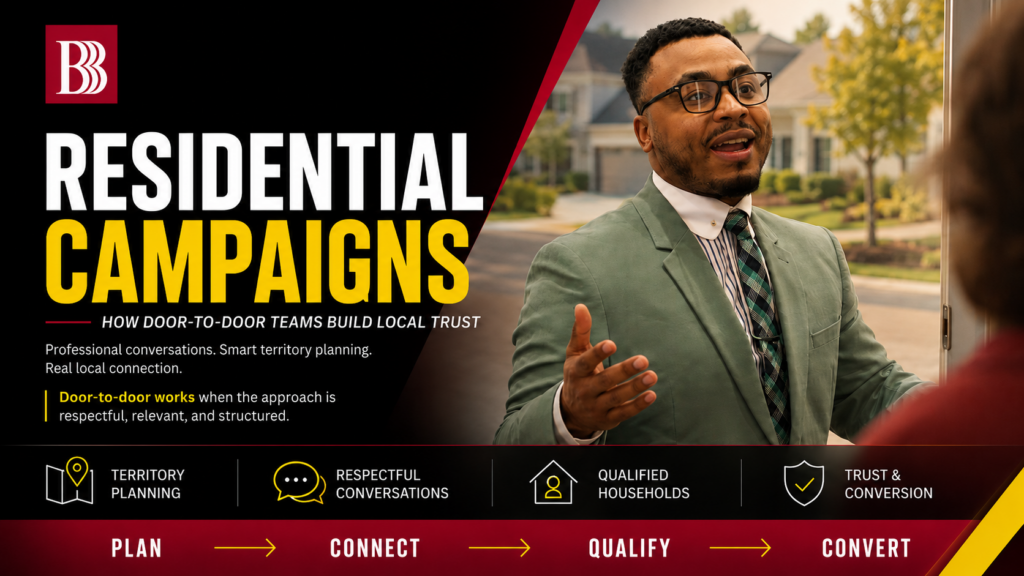
Residential campaigns remain one of the most direct ways for service brands to connect with local customers.
When done correctly, door-to-door customer acquisition is not about interrupting people or pushing a generic offer. It is about creating respectful, relevant conversations in the places where service decisions often matter most: homes, neighbourhoods and local communities.
For national and regional service providers, residential campaigns can help turn brand awareness into real customer action by combining local presence, trained representatives and structured needs-based conversations.
What Is a Residential Campaign?
A residential campaign is a face-to-face customer acquisition strategy where trained representatives engage potential customers in specific neighbourhoods or local territories.
These campaigns are often used by service-based brands because customers may need a direct explanation before making a decision. This can include offers related to household services, subscriptions, utilities, telecoms, community services or other local service categories.
At <a href=”https://bucksbamablitz.com/services/”>Bucks Bama Blitz</a>, residential campaigns are described as structured, territory-driven campaigns that use trained canvassers to reach residential neighbourhoods with tailored offers. That structure is what separates a professional campaign from random door-knocking.
Why Residential Campaigns Still Work for Service Brands
Digital advertising can create awareness, but residential campaigns create personal connection.
A customer may have seen an advert, heard of a brand or received a mailer, but still have questions. A trained representative can answer those questions directly and explain the offer in a way that feels relevant to the customer’s home or local area.
Residential campaigns can help service brands:
- Reach customers in specific territories.
- Explain offers clearly.
- Build trust through direct conversation.
- Identify qualified households.
- Understand local objections.
- Support market entry.
- Convert existing brand awareness into action.
The key is professionalism. Customers are more likely to respond positively when the conversation is respectful, transparent and useful.
Local Trust Starts With the First Impression
In residential campaigns, the first impression matters immediately.
A representative should look professional, introduce themselves clearly and explain why they are there. The customer should quickly understand the brand being represented and the purpose of the conversation.
A strong opening should be:
- Polite
- Brief
- Clear
- Relevant
- Honest
- Easy to respond to
The goal is not to overwhelm the customer at the door. The goal is to start a simple conversation and determine whether the offer is relevant.
Territory Planning Makes Campaigns More Effective
A strong residential campaign starts before the team enters the neighbourhood.
Territory planning helps ensure the campaign reaches the right audience in the right areas. This may involve reviewing:
- Service availability
- Local demand
- Customer demographics
- Previous campaign results
- Neighbourhood density
- Timing
- Travel routes
- Team coverage
- Compliance requirements
Good territory planning improves efficiency. It helps teams avoid wasted movement, missed opportunities and inconsistent coverage.
It also helps clients understand where the strongest opportunities may exist.
The Role of Needs-Based Conversations
Residential acquisition works best when representatives focus on needs rather than pressure.
A needs-based conversation may include questions such as:
- Are you currently using a similar service?
- Are you happy with your current option?
- What would make you consider switching?
- Is price, reliability, convenience or support most important to you?
- Would you like more information about how this offer works?
These questions help the representative understand whether the customer is a good fit.
This also creates a better customer experience. Instead of feeling like they are being sold to, the customer feels heard.
Bucks Bama Blitz explains on its About page that its teams conduct professional needs analysis and represent clients as an extension of their brand. This is especially important in residential environments where trust and clarity matter.
Compliance Protects the Brand and the Customer
Residential campaigns must be handled with care.
A professional team should understand the rules, expectations and conduct standards for every campaign. This may include:
- Respecting local guidelines
- Following approved scripts
- Using accurate information
- Avoiding misleading claims
- Respecting customer boundaries
- Recording consent correctly
- Following brand standards
- Escalating issues properly
Compliance is not just a legal or operational detail. It is part of the customer experience.
When representatives are clear, respectful and transparent, they protect the brand’s reputation and create stronger long-term trust.
Training Is Essential for Doorstep Conversations
Doorstep conversations can be unpredictable. Customers may be busy, curious, sceptical, interested or unsure. Representatives need training to handle those situations professionally.
A strong training process should cover:
- Brand knowledge
- Offer details
- Customer profile
- Opening message
- Qualification questions
- Objection handling
- Compliance standards
- Lead capture
- Handoff process
- Daily performance expectations
Training helps representatives stay confident and consistent.
It also helps the campaign maintain quality across different neighbourhoods and teams.
What Residential Teams Should Track
Residential campaigns should be measured with clear performance data.
Important metrics may include:
- Doors approached
- Conversations started
- Qualified households
- Customer objections
- Sign-ups or sales
- Follow-up requests
- Conversion rate
- Territory performance
- Team performance
- Post-campaign handoff quality
These metrics help service brands understand which areas, messages and approaches are producing the best results.
Bucks Bama Blitz includes daily performance tracking and post-campaign handoff as part of its face-to-face customer acquisition service model on the Services page.
Common Mistakes in Residential Campaigns
Residential campaigns can underperform when they are not planned properly.
Common mistakes include:
1. Using a Generic Pitch
Every household is different. A script should guide the conversation, not replace listening.
2. Poor Territory Coverage
Without clear routes and planning, teams may miss valuable areas or duplicate effort.
3. Weak Training
Unprepared representatives can create confusion, miss opportunities or damage trust.
4. No Clear Handoff
If customer information is incomplete or the next step is unclear, interested prospects may drop off.
5. Focusing Only on Volume
More doors do not automatically mean better results. Quality conversations matter.
Why Residential Campaigns Support Local Growth
Residential campaigns give service brands a way to understand local markets at street level.
They reveal:
- What customers already know about the brand.
- Which objections appear most often.
- Which offers feel most relevant.
- Which neighbourhoods show stronger interest.
- Which customer segments are easier to convert.
- What information customers need before making a decision.
This makes residential campaigns useful for both acquisition and market insight.
The brand is not only gaining customers. It is learning how local customers think, compare and decide.
Final Thoughts
Residential campaigns can be powerful when they are built around professionalism, planning and trust.
The strongest door-to-door teams do more than knock on doors. They represent the brand, listen to customers, qualify opportunities, explain offers clearly and create a smooth path from conversation to customer.
For service brands that already have awareness but need stronger local conversion, residential campaigns can be a practical and measurable acquisition channel.
To learn how Bucks Bama Blitz supports residential campaigns, event-based sales, B2B acquisition and face-to-face customer acquisition, visit the Services page or get in touch with the team.
FAQs
What is a residential campaign?
A residential campaign is a door-to-door customer acquisition strategy where trained representatives engage potential customers in specific neighbourhoods or local territories.
Why do service brands use residential campaigns?
Service brands use residential campaigns to explain offers directly, answer customer questions, build local trust and convert qualified households.
What makes a door-to-door campaign professional?
A professional door-to-door campaign includes trained representatives, clear messaging, compliance standards, territory planning, respectful conversations and accurate lead capture.
How can residential campaigns be measured?
Residential campaigns can be measured through conversations, qualified households, conversions, objections, territory performance, team performance and post-campaign handoff quality.