Strong brand awareness is valuable, but awareness alone does not always create customers.
A customer may recognise a national service brand, remember seeing its advertising or already know the company name. However, when it comes time to make a service decision, they often still need clarity, reassurance and a reason to act.
That is where needs-based selling creates value.
Needs-based selling helps service brands turn recognition into real customer acquisition by focusing on the customer’s situation first. Instead of leading with a generic pitch, representatives ask the right questions, understand the customer’s needs and recommend a solution that feels relevant.
For service-based brands, this approach can make face-to-face engagement more professional, more consultative and more effective.
What Is Needs-Based Selling?
Needs-based selling is a consultative sales approach built around understanding the customer before presenting a solution.
Rather than starting with “Here is what we offer,” the conversation starts with questions such as:
- What are you currently using?
- What matters most to you in this service?
- Are you happy with your current provider?
- What would make you consider a change?
- What problem are you trying to solve?
- What would make this easier or more valuable for you?
This helps the representative identify whether the offer is a good fit.
At Bucks Bama Blitz, the company positions face-to-face customer acquisition around professional engagement, needs analysis and tailored solutions for established service-based brands. That makes needs-based selling a natural part of its customer acquisition model.
Why Service Brands Need More Than Awareness
Service brands often invest heavily in digital advertising, media, sponsorships and brand visibility. These channels help create recognition, but they do not always answer the customer’s personal questions.
A customer may still wonder:
- Is this service right for my household or business?
- Is switching worth it?
- Will the process be simple?
- What happens after I sign up?
- How does this compare to my current provider?
- Can I trust the representative?
Face-to-face acquisition gives service brands the opportunity to answer those questions directly.
A trained representative can turn a passive impression into an active conversation. That conversation can then become qualification, a tailored recommendation and a clear next step.
The Difference Between Pitching and Consulting
A pitch talks at the customer. A consultative conversation talks with the customer.
That difference matters.
Pitching often focuses on speed, volume and memorised talking points. Consulting focuses on listening, relevance and fit. For service brands, this is especially important because customers are often making decisions that affect their home, business, monthly costs or long-term provider relationship.
A needs-based conversation should feel structured but natural.
The representative should be able to:
- Explain the brand clearly.
- Ask simple qualification questions.
- Listen to the customer’s concerns.
- Match the offer to the customer’s situation.
- Avoid pressure-based selling.
- Guide the customer towards a practical next step.
This protects both the customer experience and the brand reputation.
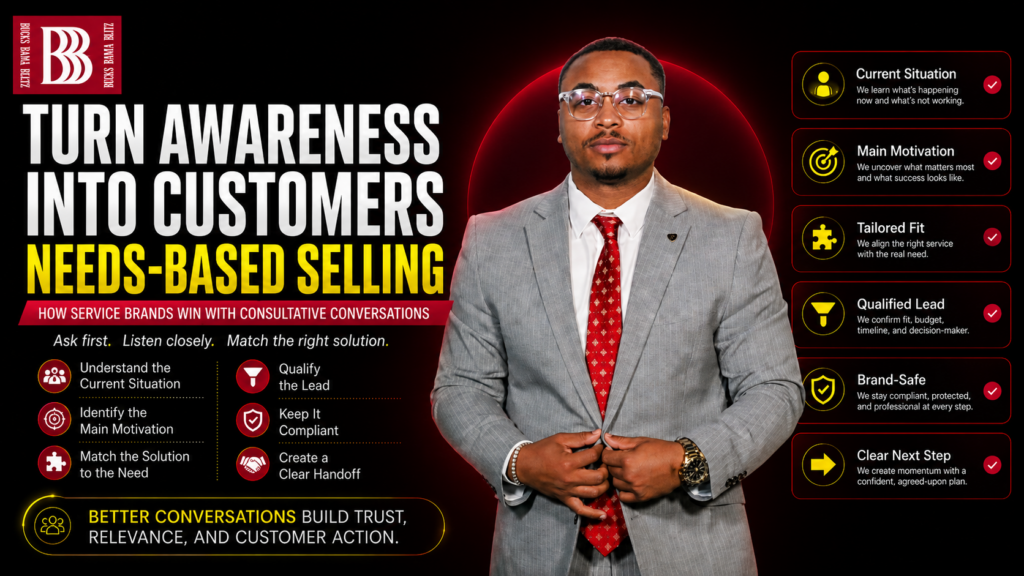
Step 1: Understand the Customer’s Current Situation
The first step in needs-based selling is understanding where the customer is starting from.
For a service-based brand, this may include asking about:
- Current provider
- Current level of satisfaction
- Service needs
- Budget expectations
- Location availability
- Pain points
- Contract or switching concerns
- Decision timeline
These questions help the representative avoid making assumptions.
For example, two customers may be interested in the same service but for completely different reasons. One may care about reliability. Another may care about price. Another may want convenience. Another may be looking for better support.
A strong needs analysis helps the conversation become more relevant.
Step 2: Identify the Customer’s Main Motivation
Customers do not usually make service decisions because of one feature alone. They make decisions because the offer solves a specific problem or improves their situation.
Common motivations may include:
- Saving money
- Improving reliability
- Getting better customer support
- Simplifying a service
- Accessing a new offer
- Supporting a cause
- Upgrading from a weaker provider
- Finding a better fit for their household or business
Once the representative understands the motivation, they can explain the offer in a way that matters to that customer.
This is much more effective than repeating the same message to everyone.
Step 3: Match the Solution to the Need
Needs-based selling works best when the solution is clearly connected to the customer’s concern.
For example:
- If the customer cares about value, explain the practical benefits.
- If the customer cares about reliability, focus on service consistency.
- If the customer has questions, slow down and clarify.
- If the customer is comparing options, explain the difference clearly.
- If the customer is not ready today, define the best follow-up step.
The goal is not to force every conversation into a close. The goal is to guide qualified customers towards a decision that makes sense.
This is why Bucks Bama Blitz describes its model as consultative, compliant and results-driven across events, residential campaigns and B2B acquisition on its Services page.
Step 4: Use Qualification to Protect Lead Quality
A needs-based approach also improves lead quality.
Instead of collecting every possible contact, representatives can identify which customers are more likely to convert and which are not the right fit.
A qualified opportunity may include:
- A clear need
- Interest in the offer
- Eligibility for the service
- Accurate contact details
- Permission for follow-up
- A realistic decision timeline
- A reason to consider switching or signing up
This helps service brands avoid wasting time on low-intent prospects.
It also supports a smoother handoff after the campaign, because the follow-up team receives better information.
Step 5: Keep the Conversation Compliant and Brand-Safe
For national service brands, customer acquisition must be handled carefully. Representatives are not only selling; they are representing the brand in person.
That means every conversation should be:
- Honest
- Clear
- Professional
- Respectful
- Accurate
- Compliant
- Consistent with brand standards
A short-term sale should never come at the cost of long-term trust.
Bucks Bama Blitz highlights high integrity, compliance standards and professional trained representatives on its About page. This is important because service brands need acquisition partners who can protect the customer experience while still driving measurable results.
Step 6: Create a Clear Handoff
A strong customer conversation should not end in confusion.
Once the customer has shown interest or completed the next step, the handoff should be clear. This may include:
- Confirming customer details
- Explaining what happens next
- Setting expectations
- Recording notes
- Passing information to the client or internal team
- Scheduling follow-up if needed
The handoff is where many campaigns lose value. If the customer does not understand the next step, or if the sales team does not receive accurate information, the opportunity can weaken.
A structured post-campaign handoff helps turn face-to-face activity into measurable customer acquisition.
Why Needs-Based Selling Helps Brands Grow
Needs-based selling helps service brands grow because it improves the quality of each interaction.
It allows brands to:
- Convert existing awareness into action.
- Understand customer concerns in real time.
- Improve qualification.
- Reduce wasted conversations.
- Protect brand reputation.
- Create stronger customer experiences.
- Generate more reliable sales outcomes.
For companies that already have brand recognition, the opportunity is not only to become more visible. The opportunity is to turn that visibility into trust, relevance and customer decisions.
Final Thoughts
Service brands do not need more noise. They need better conversations.
Needs-based selling gives face-to-face teams a structured way to understand customers, recommend relevant solutions and convert awareness into measurable growth.
When representatives listen first, qualify properly and communicate clearly, customer acquisition becomes more than a numbers game. It becomes a trust-building process that supports long-term brand growth.
To learn how Bucks Bama Blitz supports service brands with professional face-to-face customer acquisition, visit the Services page or contact the team to discuss your next campaign.
FAQs
What is needs-based selling?
Needs-based selling is a consultative sales approach that focuses on understanding the customer’s situation before recommending a product or service.
Why is needs-based selling important for service brands?
It helps service brands create more relevant conversations, improve lead quality, answer customer concerns and turn brand awareness into real customer acquisition.
How does face-to-face selling support needs analysis?
Face-to-face selling allows representatives to ask questions, listen to objections, understand customer needs and tailor the conversation in real time.
What makes a customer acquisition conversation effective?
An effective conversation is clear, honest, consultative, compliant and focused on matching the customer with a solution that fits their needs.